
In France, the law mandates priority access in all establishments open to the public, not just at checkouts marked by a pictogram. This obligation, enshrined in the Social Action and Families Code, applies to all queues in a store. However, the confusion between “dedicated priority checkout” and “right of priority” remains widespread, even among store staff.
Priority at automatic checkouts and self-checkout: the forgotten issue
Articles on the subject focus almost exclusively on traditional checkouts with cashiers. The rise of self-checkout areas creates a regulatory blind spot that few retailers have anticipated.
Since 2023, several large retail chains have been testing adapted devices: a “priority for disability/pregnancy” call button directly on the kiosk, or the intervention of a floating employee to open a passage in the queue at automatic checkouts. The Federation of Commerce and Distribution (FCD) mentions these adaptations in its report “Commerce by 2030” as a project related to the rise of self-checkout.
The problem remains tangible. A person holding a mobility inclusion card (CMI) who approaches six self-service kiosks without visible staff has, in practice, no one to assert their right. The absence of a cashier neutralizes the right of priority in the majority of current configurations.
Some retailers are starting to train “zone ambassadors” tasked with managing the flow at automatic checkouts, but feedback from the field varies on the actual effectiveness of the system. The question of whether all checkouts are priority in stores takes on a new dimension when half of the checkouts no longer have a human operator.
Right of priority in stores: what the law really imposes
French legislation does not mention the term “priority checkout.” It refers to a requirement for priority access to establishments open to the public for certain categories of people. This nuance changes the understanding of the issue.
In practice, the right of priority applies to all queues in the store, not just to the checkout marked by a logo. Whether it is the express checkout, the classic checkout number 7, or the reception desk, a priority person can pass ahead of other customers.
Groups entitled to priority at checkout
- People with disabilities holding a mobility inclusion card (CMI) marked “priority” or “disability,” including for invisible disabilities (fibromyalgia, multiple sclerosis, chronic inflammatory bowel diseases)
- Pregnant women, upon presentation of a medical certificate or a clear visible sign of pregnancy, according to the practices of the stores
- Older persons with reduced mobility, using a cane, walker, or wheelchair, even without a CMI card
- Accompanying persons of priority individuals: family caregivers, personal assistants, French sign language interpreters
The CMI card marked “priority” allows passing ahead at any checkout, not just at the designated one. Retailers that restrict this right to a single checkout do not comply with the legal framework.
Dedicated priority checkouts or priority at all checkouts: two models coexist
Practices vary among retailers and the size of the store. Two approaches stand out.
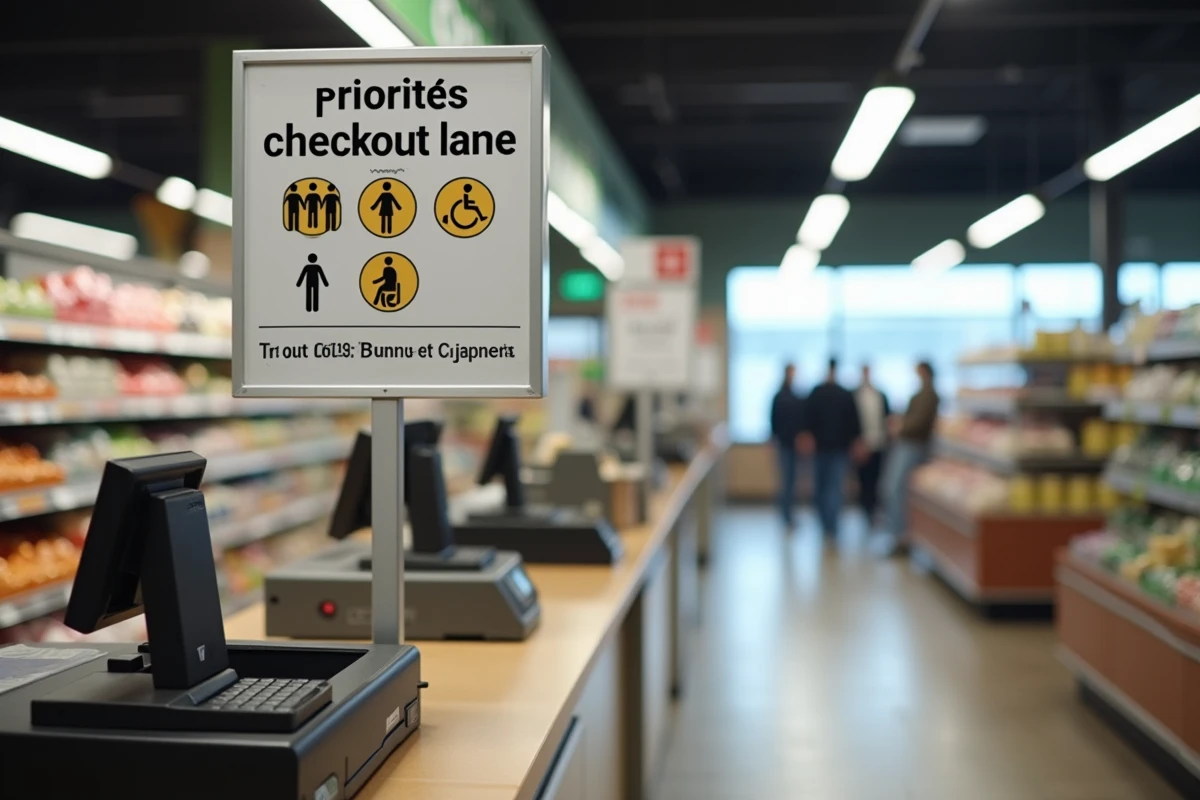
The historical model remains the dedicated checkout, identified by a pictogram (wheelchair, pregnant woman). In large hypermarkets, this checkout is often placed near the main exit to limit walking distance. Able-bodied customers can sometimes access it when no priority person is waiting, but some stores explicitly prohibit this to avoid congestion.
The second, more recent model abandons the dedicated checkout in favor of a priority applicable to all open checkouts. Cashiers are instructed to interrupt the flow to allow a priority person to pass wherever they present themselves, without specific signage. The Ministerial Delegation for Accessibility has documented these experiments with “100% flexible” queues in a working group report published in 2023.
This flexible model solves a recurring problem: the single priority checkout, often closed during off-peak hours or overwhelmed during peak times, paradoxically creates more waiting for the people it is supposed to protect.

Invisible disability and priority checkout: the daily friction
The legal framework grants the same rights to individuals whose disabilities are not visible. In practice, asserting this right without facing comments remains difficult.
A person with fibromyalgia or multiple sclerosis may struggle with standing for long periods without any external indication. The CMI marked “priority” is the only enforceable document to justify priority passage. No retailer has the right to demand additional medical documentation.
The Handivisible system, adopted by several retailers including Carrefour in certain departments, attempts to address this friction. The principle: a discreet reporting system that informs checkout staff of the arrival of a priority person, without them having to justify themselves publicly in front of other customers. Over 300 stores use this type of system according to data provided by the company.
What to do in case of refusal at checkout
A refusal of priority constitutes an infringement. The person concerned can request to speak to the store manager and, if the refusal persists, report the situation to the departmental directorate for population protection (DDPP). Photographing the display (or its absence) in the store can serve as evidence.
Retailers have an obligation to display visible reminders of the right of priority. The absence of a sign does not eliminate the right, but it facilitates refusals due to ignorance.
The right of priority at checkout does not depend on the goodwill of a retailer or the presence of a pictogram in a specific aisle. It applies to the entire store, to all open checkouts, and adaptations to new configurations (self-checkout, dematerialized queues) remain a largely unfinished project.