
Consulates and embassies represent France abroad, but their interlocutors are not the same. The embassy addresses the government of the host country, while the consulate serves French nationals and foreigners in need of France. This distinction, seemingly simple, becomes blurred in practice: consular agents working within the premises of an embassy, digital processes eliminating the need for a physical visit to the counter, honorary consuls with limited prerogatives.
Consular section integrated into the embassy: a blurred institutional boundary
Most competitors present embassies and consulates as two well-separated entities. The reality tells a different story. In many countries where the French community remains modest, there is no separate consulate: consular functions are carried out within the embassy itself.
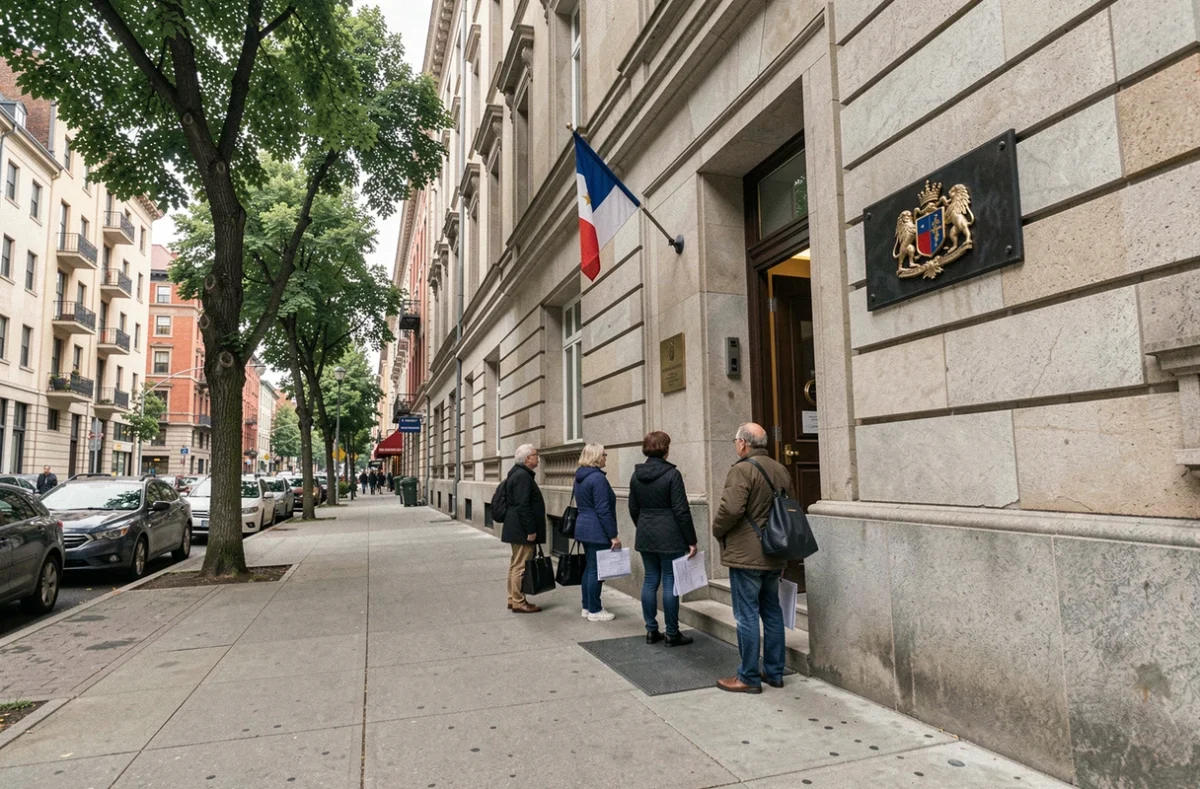
A recent job offer from the French embassy in Lisbon illustrates this blurring. The position involved “multiple consular functions,” meaning that the same agent, in the same building, handles both bilateral diplomatic relations and requests for passports or civil status. For the national who pushes the door, the distinction between embassy and consulate has no physical translation.
This case is not isolated. In capitals where a general consulate coexists with the embassy (London, New York, Istanbul), the two structures occupy different addresses and manage separate queues. However, in the majority of smaller diplomatic posts, the separation remains purely organizational. Understanding the difference between consulate and embassy therefore requires looking beyond the label on the door.
Diplomatic missions of the embassy: beyond the classic bilateral relationship
The embassy is headed by an ambassador appointed by the President of the Republic. Its primary role is to convey the French position to the authorities of the host country: political negotiations, trade agreements, cultural and scientific cooperation, security monitoring.

Recent communications from the French diplomatic network show that this mission far exceeds the traditional bilateral framework. Embassies are mobilized on transnational issues: securing energy supplies, international health coordination, preparing sessions of the United Nations General Assembly. The ambassador does not only speak to the local foreign minister; he also relays French priorities in multilateral forums hosted by the host country.
What the embassy generally does not do: issue a passport, transcribe a birth certificate, organize medical repatriation. These tasks fall under the consulate or, in its absence, the integrated consular section.
Consular services: what the consulate concretely manages for French nationals abroad
The consul (or the consul general in large cities) manages administrative acts that directly affect nationals. His scope covers a territory called the consular district, which can encompass an entire country or a region of a large country.
The most common procedures fall into a few categories:
- Civil status and identity: issuance and renewal of passports, transcription of births, marriages, and deaths occurring abroad, national identity cards.
- Protection and consular assistance: help in case of arrest, hospitalization, natural disaster, or conflict, emergency repatriation.
- Electoral procedures: registration on consular electoral lists, establishment of proxies, organization of voting for national elections.
- Visas: processing visa applications for foreign nationals wishing to travel to France (this mission is sometimes outsourced to private providers).
The honorary consul, often a local national or an expatriate appointed by France, has more limited prerogatives. He can authenticate certain documents or serve as a relay in case of emergency, but he does not issue passports or visas.
Digital identity and dematerialization: is the physical consulate losing its monopoly?
Since May 2025, digital identity certification is accessible to French nationals residing abroad. This development allows online procedures that previously required a visit to the consulate. The physical counter remains necessary for biometrics (fingerprints, photo), but part of the administrative processing is shifting to digital platforms.
An internet voting test has also been launched via a call for volunteers, opening the possibility of registering a proxy without appearing at the consulate. If this system becomes widespread, the consulate will become less of a mandatory stop and more of a last-resort assistance service.
This dematerialization does not affect the embassy in the same way. Diplomatic negotiations, exchanges of verbal notes, and official receptions remain activities that are inherently in-person. However, the political and economic analysis produced by embassies is already widely circulated in digital form to the Quai d’Orsay.
Embassy or consulate: knowing which door to knock on depending on the situation
The basic rule remains simple: any personal administrative procedure (identity papers, civil status, assistance in case of difficulty) falls under the consulate or the consular section of the embassy. Any question regarding relations between France and the host country (trade policy, defense cooperation, protocol) falls under the embassy.
Ambiguous cases exist. A French entrepreneur facing a commercial dispute with a local company may seek support from the economic service of the embassy for institutional backing while also requesting assistance from the consulate if the situation escalates into personal litigation. The two institutions are not compartmentalized: they often share premises, information, and agents.
The most reliable reflex is to consult the directory of the Ministry of Europe and Foreign Affairs, which indicates for each country the list of diplomatic and consular posts, their contact details, and their territorial competencies. In countries where only an embassy is present, it assumes all functions, including consular ones.