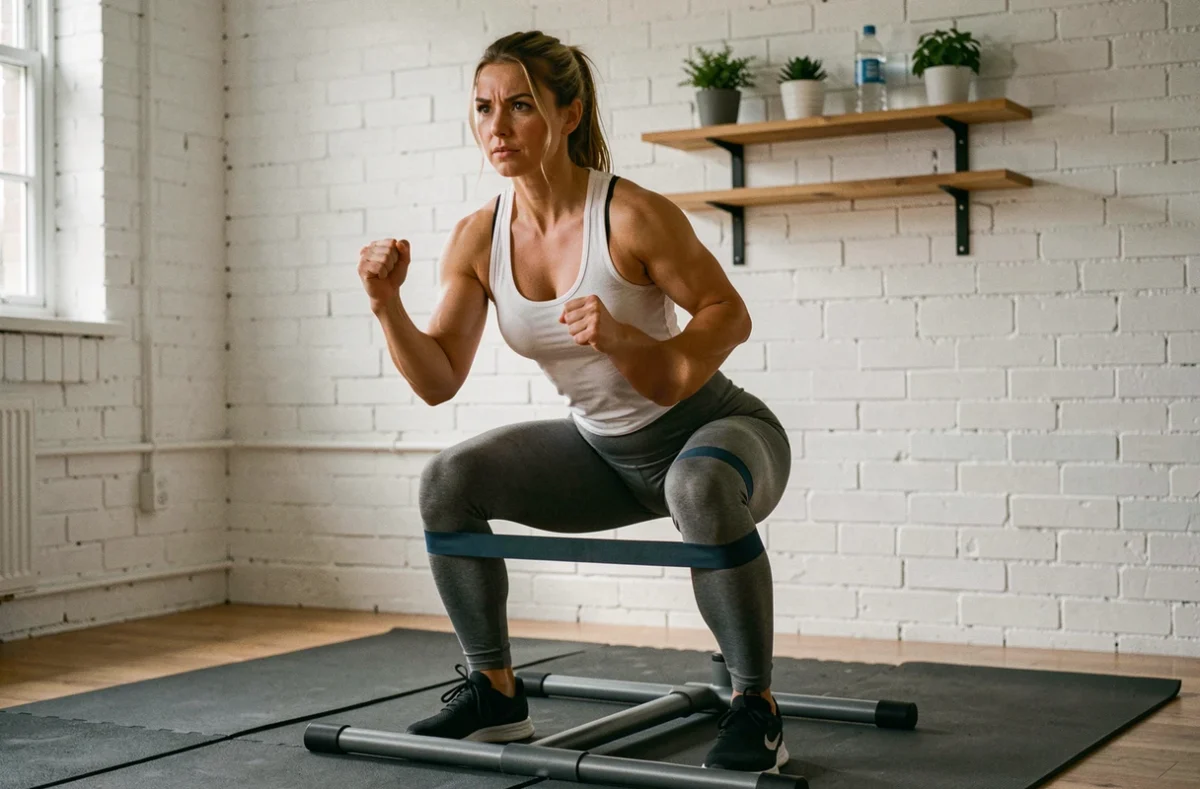
A free-weight barbell squat at home works the quadriceps, hamstrings, glutes and adductors through a full range of motion, but it requires a rack, reinforced flooring and flawless technique. For most home gym users, choosing equipment should start with one question: can the resistance increase enough to keep you progressing without hitting a plateau after a few months?
Progressive overload in a home gym: the factor that sets leg equipment apart
Equipment that reaches its maximum load within a few weeks becomes a limiting factor. The capacity for progressive overload is the most important technical criterion, well ahead of footprint or price.
On a leg press, resistance increases by adding weight plates. With a sissy squat, you can adjust the difficulty by changing the incline or adding weight. With resistance bands, you can combine several bands or shorten the working length. Every system has a ceiling, and that ceiling determines how long your investment will remain useful.
Choosing a leg workout machine therefore means estimating how much room you have to progress over at least a year. An intermediate lifter who already squats more than their body weight will get little use from equipment capped at a modest load.
The ACSM notes that training to complete muscular failure does not necessarily produce better strength or hypertrophy results. A high but controlled effort, with one to three reps in reserve, is enough. This puts claims about equipment promising a maximum “burn” into perspective: consistent progressive overload matters more than occasional intensity.
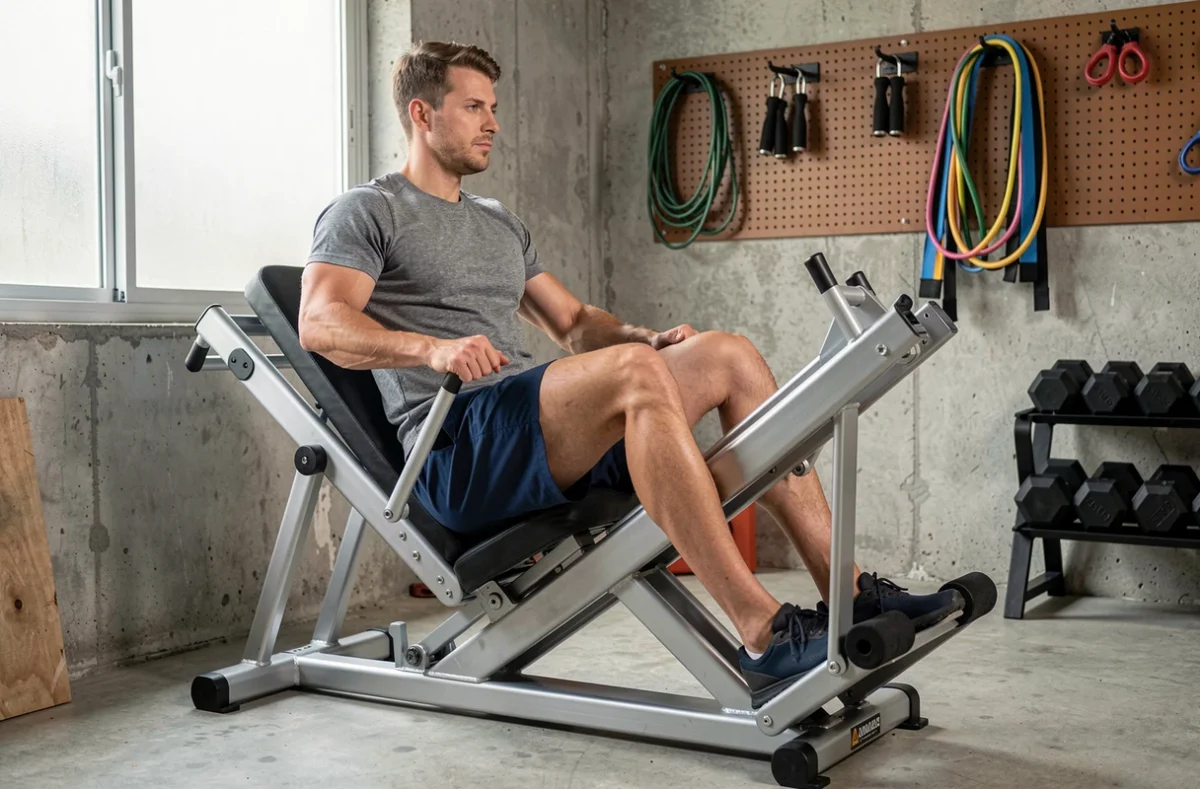
Leg press or hack squat: which station should you choose for a compact home gym?
The leg press (inclined or vertical) and hack squat involve similar, but not identical, movement patterns. We recommend choosing based on the space available and your injury history.
Incline leg press
The incline leg press keeps your back against a fixed backrest and reduces axial stress on the spine. Knee flexion range is easy to standardize, making it suitable for people with lower back pain. Its working load can be increased substantially with Olympic weight plates.
Its main drawback in a home gym is its footprint. Expect a long frame that is difficult to fold away.
Hack squat
The hack squat follows a guided vertical path, with your shoulders positioned under the pads. It targets the quadriceps more directly, recruiting the glutes less than the incline leg press. However, patellofemoral pressure increases in the final degrees of flexion, which is worth monitoring if you have a history of kneecap problems.
Some manufacturers offer combined leg press/hack squat stations on a single frame—a useful compromise when you have only a few square metres of floor space.
Leg extension and leg curl: useful additions or unnecessary extras?
Single-joint isolation machines (leg extensions for the quadriceps and leg curls for the hamstrings) are often overlooked in general fitness guides. Their usefulness depends on your goal.
- For rehabilitation or injury prevention, the leg curl lets you target the hamstrings without loading the spine—an important advantage after a back or knee injury.
- For hypertrophy, the leg extension adds targeted volume for the vastus medialis and rectus femoris, two quadriceps muscles that receive less work during deep squats.
- For a budget-conscious home gym, a combined extension/curl station on a single bench costs less and takes up less space than two separate machines.
Isolation work only makes sense once your compound movements are in place. Adding a leg extension without squats, leg presses or lunges is like fine-tuning a detail before laying the foundation.
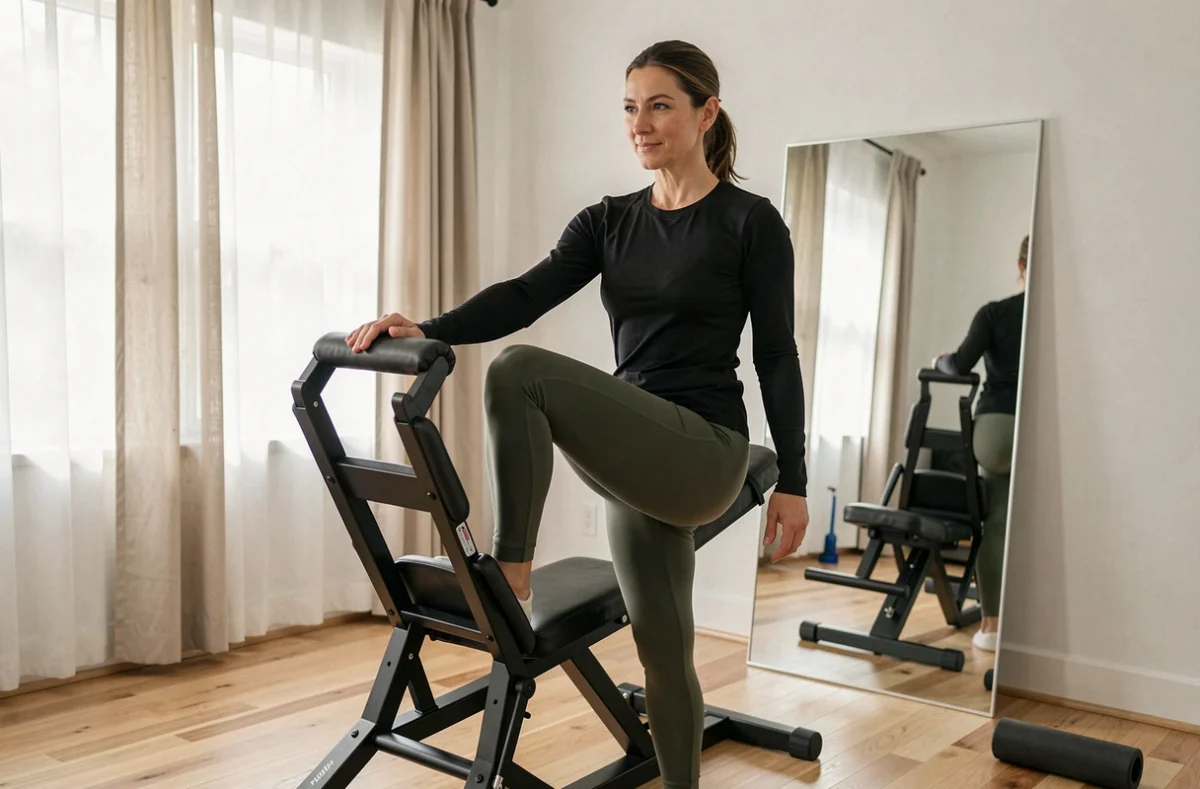
Underrated accessories for training your legs at home
A squat rack with an Olympic barbell is the most versatile station: back squats, front squats, lunges, good mornings and hip thrusts. A wall-mounted folding rack frees up space between workouts, which is a decisive advantage in a garage or shared room.
Resistance bands are worth mentioning not as a replacement, but as a way to accommodate resistance. Attached to a bar or rack, they change the force curve by adding tension at the top of the movement, where joint leverage is most favourable. This is no gimmick: it is a principle that has been used in strength and conditioning for decades.
Kettlebell and goblet squat
A heavy kettlebell (over 24 kg) lets you perform goblet squats through a full range of motion while challenging your trunk to resist flexion. The limitation is clear: the maximum load of a kettlebell quickly becomes insufficient for an advanced lifter. It remains an excellent warm-up or circuit-training tool.
Weighted step-up and elevated split squat
A sturdy bench or plyometric box is all you need for step-ups and Bulgarian split squats. These unilateral exercises help correct strength imbalances between the right and left legs—a common issue that bilateral machines do not reveal.
- Step-ups target the glutes and hamstrings more when the step is higher than knee level.
- The Bulgarian split squat, with the rear foot elevated, places the load on the front-leg quadriceps while strongly stretching the rear-side iliopsoas.
- Both movements are easy to load with dumbbells and require neither a rack nor a barbell.
A complete home leg program combines a heavy bilateral movement with a weighted unilateral movement. The leg press or rack squat provides the strength stimulus, while the split squat or step-up addresses imbalances. Adding an isolation machine such as a leg curl for the hamstrings rounds out the program without complicating your setup. Other options—kettlebells, bands and sissy squats—can be added based on your budget and available space, not the latest trend.